
Why Enterprises Are Moving Workloads Out of the Public Cloud

For years, the “cloud-first” approach dominated enterprise IT strategy. Organisations moved applications and workloads to public cloud platforms to gain speed, scalability, and flexibility.
But in 2026, that approach is being reconsidered.
More organisations are now repatriating selected workloads, moving them back from public cloud to private, on-premise, or hybrid environments. According to the Flexera 2025 State of the Cloud Report, over one-fifth of workloads and data have already been repatriated globally. Separately, a Barclays CIO Survey found that 83% of enterprise CIOs planned to move at least some workloads back to private infrastructure, the highest level ever recorded.
This is not a rejection of the cloud. It is a more deliberate approach to where workloads belong.
Why Organisations Are Pulling Workloads Back

Several factors are driving the cloud repatriation trend.
Cost Predictability
Public cloud pricing can be difficult to forecast. Variable consumption models, storage tiers, and data egress fees add up. For stable, long-running workloads, private infrastructure often offers more predictable costs.
The IDC repatriation report notes that unpredictable cloud costs have become a leading driver of repatriation decisions, with 59% of organisations spending more than budgeted on cloud in 2024. For workloads with consistent, predictable demand, the economics of private or edge infrastructure simply make more sense.
Performance and Latency
Mission-critical applications such as financial systems, analytics platforms, and IoT solutions require consistent, low-latency performance. Shared public cloud environments do not always meet these demands reliably.
Latency is particularly critical for real-time workloads. When data must travel to a distant centralised data centre for processing, delays compound, affecting everything from transaction speeds to user experience. Moving workloads closer to the point of use addresses this directly.
Security, Compliance, and Data Sovereignty
Regulatory requirements and growing cybersecurity concerns are prompting organisations to retain tighter control over sensitive data and infrastructure. Keeping workloads within defined boundaries makes compliance easier to manage.
In Singapore, the Personal Data Protection Act (PDPA) requires organisations to ensure that personal data transferred outside Singapore maintains comparable protection standards. Amendments effective in 2024 and 2025 introduced mandatory data breach notifications and greater accountability obligations. For regulated industries such as financial services and healthcare, keeping data within Singapore’s borders is becoming an operational and legal priority.
Avoiding Vendor Lock-In
Relying on a single hyperscaler introduces risk. Organisations are diversifying their infrastructure strategies to maintain flexibility and reduce dependency on any one provider. As IDC research vice president Natalya Yezhkova notes, organisations should reassess cloud value regularly, because workload needs, regulations, and provider pricing all change over time.
Hybrid Infrastructure Is the New Default
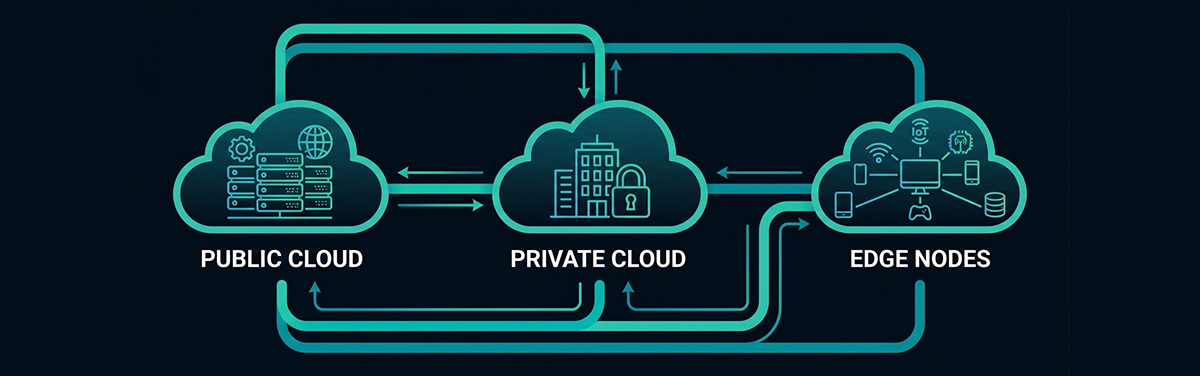
The result of these shifts is clear: hybrid infrastructure is becoming the standard approach.
According to the Flexera 2025 State of the Cloud Report, 70% of enterprises already use a hybrid cloud strategy, combining at least one public and one private cloud. Organisations are distributing workloads across environments to ensure each one runs where it delivers the best value, balancing performance, cost, and compliance requirements.
This is where edge cloud solutions play an important role.
How Edge Cloud Supports a Hybrid Strategy

As hybrid infrastructure becomes the norm, a common question arises: which environment should a workload run in? The answer depends on what the workload actually needs.
Public cloud is best suited for organisations that need access to managed SaaS or PaaS offerings, such as those provided by AWS, Azure, or Google Cloud. It works well for elastic, variable workloads where on-demand scalability outweighs cost predictability.
Private cloud is the right fit when governance is the primary concern. Regulated industries such as banking and financial services often operate a relatively small number of virtual machines to support internal business users. Running these on public cloud raises costs significantly and introduces exposure over the Internet, which many compliance frameworks do not permit.
Edge cloud sits in the middle. It is suited for organisations that want a private connection to their workloads without the full feature set of a hyperscaler. For businesses looking to offload capital expenditure without the complexity of public cloud, edge cloud provides dedicated compute resources, predictable costs, and a secure, private environment.
Understanding these distinctions helps organisations make more deliberate decisions about workload placement, rather than defaulting to a single cloud provider for everything.
To understand what edge cloud is and how it works, read our article: What is Edge Cloud Infrastructure & How Can It Power AI Innovation?
Power Your Hybrid Strategy with SPTel Edge Cloud

SPTel Edge Cloud is a secure, locally hosted infrastructure-as-a-service platform built for hybrid and repatriated workloads. It is accredited under Singapore’s Multi-Tier Cloud Security (MTCS) scheme, affirming its compliance with local security standards.
Ultra-low latency performance: Compute resources are positioned closer to users and devices, enabling faster application response times where it matters most. SPTel’s edge hubs achieve sub-1ms latency across its core network and edge hub zones, making it well-suited for time-sensitive applications.
Singapore-based data sovereignty: Infrastructure is hosted in secure Critical Information Infrastructure (CII) facilities within Singapore. Sensitive data stays within our shores, supporting your organisation’s obligations under the PDPA and sector-specific regulations.
Predictable infrastructure costs: Dedicated resources and transparent pricing help organisations regain control over IT expenditure, without unexpected egress charges. SPTel’s Edge Cloud carries no egress fees between devices and edge compute, offering up to 20% savings versus typical service charges.
Hybrid cloud connectivity: Direct integration with major public clouds via SPTel’s Cloud Connect services enables seamless connectivity across private, edge, and public cloud environments.
Flexible infrastructure options: From virtual machines to bare metal servers, organisations can deploy workloads based on their specific performance and control requirements. Resources can be scaled on demand via SPTel’s unified cloud management portal.
With SPTel, you can design a hybrid cloud strategy that supports workloads in the right environment, whether that is the public cloud, a private environment, or the edge. Explore SPTel Edge Cloud to find out how our infrastructure can support your organisation’s next move.