
Singapore Esports Events: Tournament-Grade Networks for Competitive Gaming

Singapore’s esports market is growing fast. Valued at USD 9.78 million in 2024, it is projected to reach USD 42.18 million by 2033, growing at a 17.58% CAGR. This growth mirrors a broader global trend, with the global esports market expected to expand from USD 2.13 billion in 2024 to USD 7.46 billion by 2030, driven by sponsorships, media rights, and competitive gaming.
Behind every successful tournament, however, is a network that can keep up. Professional esports tournaments demand enterprise-grade connectivity that far exceeds what typical commercial broadband can offer. Sub-millisecond latency and zero packet loss are not optional. They are the foundation of fair, competitive play.
This is why many organisers turn to LAN (Local Area Network) setups for major events, eliminating Internet latency variability and ensuring consistent performance. For tournament organisers and venue operators, this raises an important question: is your network infrastructure built to meet these demands?
This article explores what it takes to power a professional esports event, and how the right connectivity solutions can make the difference.
Latency Requirements: The Foundation of Competitive Gaming

Sub-20ms Latency: The Esports Gold Standard
In competitive gaming, milliseconds matter. Professional esports tournaments enforce strict ping limits under 50 milliseconds, with 0 to 20ms considered the gold standard for titles like first-person shooters (FPS), real-time strategy (RTS) games, and fighting games.
Even within the 20 to 50ms range, players experience detectable input lag. At the highest levels of play, this gap is enough to decide a match. This is why professional players routinely demand LAN environments at major tournaments, or even relocate closer to game servers, to eliminate any variability in their connection.
For venue operators, meeting this standard requires network infrastructure built for precision, not just speed.
Zero Packet Loss Tolerance
Latency is only part of the equation. Competitive gaming demands zero packet loss. Even a 1% packet loss rate introduces lag spikes that compromise competitive fairness.
When packets are lost and retransmitted, they introduce latency variability, or jitter. In split-second engagements, jitter can disrupt the responsiveness players rely on. A network that cannot guarantee packet integrity is not fit for professional play.
Live Streaming and Broadcast Infrastructure

High-Bandwidth 4K Streaming Requirements
Modern esports events are not just played. They are broadcast to global audiences. Broadcasting in 4K requires a minimum of 34 Mbps for 4Kp30, and up to 50 Mbps for 4Kp60, the standard expected at top-tier competitive events.
When streaming simultaneously to platforms like YouTube, Twitch, and Facebook, bandwidth demands multiply further. Industry best practice recommends planning for 2 to 3 times the minimum bandwidth requirement, accounting for audio, overhead, and failover contingency.
For venue operators, this means your network must support both the game servers and the broadcast infrastructure simultaneously, without compromising either.
Cybersecurity and DDoS Protection

The Escalating DDoS Threat
Cybersecurity is a growing concern for esports operators. The gaming industry has seen a 94% increase in layer 7 DDoS attacks, with overall attacks climbing 41% year-on-year.
The scale of these attacks is significant. Record DDoS attacks exceeding 29.69 Tbps have targeted major platforms including Steam, Riot Games, Epic Games, and AWS. These are not isolated incidents.
The motivations behind these attacks range from match-fixing and betting manipulation to straightforward extortion. For tournament organisers, a successful DDoS attack during a live event can be catastrophic. Having on-demand DDoS protection available is no longer a nice-to-have. It is a necessity.
SPTel’s Enterprise Connectivity Solutions for Esports

Dedicated Enterprise Internet: Ultra-Low Latency
SPTel’s high bandwidth solution delivers ultra-low latency performance and extremely low jitter, meeting the stringent requirements of professional tournament environments. With symmetric 10 Gbps bandwidth, it provides the capacity needed to support game servers, multi-stream broadcast setups, and production equipment simultaneously, without contention.
Network Diversity and Redundancy
SPTel’s network is built on unique fibre pathways that run alongside Singapore’s power network cables. This design is physically distinct from incumbent telcos, meaning disruptions to shared infrastructure do not affect SPTel’s network.
SPTel’s diverse fibre pathways also support automatic failover capabilities, reducing the risk of single points of failure during tournaments. This is complemented by multi-ISP peering and diverse routing, which help prevent congestion impacts during peak event periods.
Bandwidth on Demand
Tournament traffic is not constant. Player counts, broadcast feeds, and spectator loads fluctuate throughout an event. SPTel’s Bandwidth on Demand capability allows instant scaling for peak tournament periods without requiring contract changes.
This flexibility means multi-team tournaments can be accommodated through dynamic expansion as needed. The pay-per-use model also ensures that costs are aligned with actual demand, avoiding unnecessary expenditure on oversized plans.
Clean-Pipe DDoS Protection
SPTel’s Internet services include built-in DDoS attack detection. The network monitors traffic patterns continuously, generating automatic alerts when suspicious activity is detected.
On-demand DDoS protection can be activated instantly, providing multi-layer attack filtering against volumetric, protocol, and application-level threats. This gives tournament organisers the ability to respond to threats in real time, without disrupting the event.
Enterprise Grade Connectivity is a Competitive Advantage
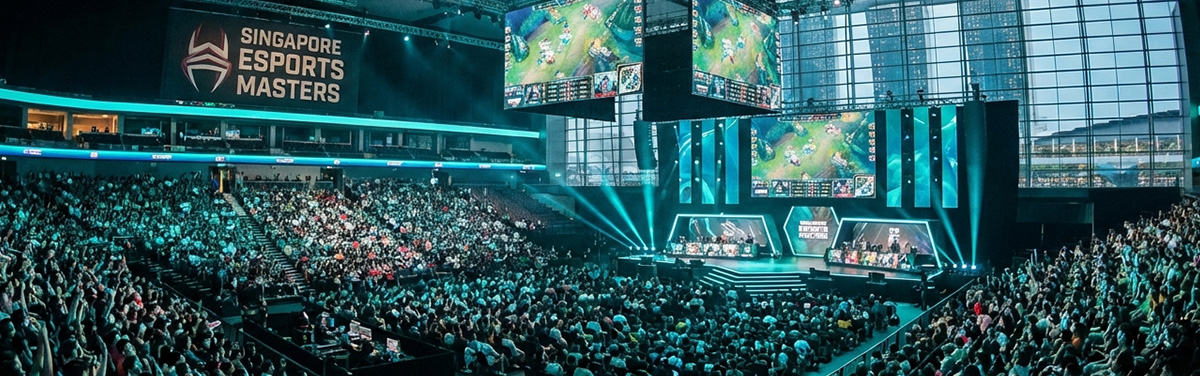
Singapore’s esports market is on a strong growth trajectory, and the demand for tournament-grade infrastructure will only increase. Sub-1ms latency across SPTel’s core network meets the performance demands of professional tournament environments, while escalating DDoS threats make robust, on-demand cybersecurity a critical requirement for any serious esports venue.
With SPTel, you can build the connectivity foundation your tournaments need. From ultra-low latency fibre and bandwidth on demand, to clean-pipe DDoS protection and a resilient, diverse network, SPTel provides the infrastructure to support world-class competitive gaming experiences.
Contact our experts today to find out how SPTel’s enterprise connectivity solutions can support your next esports event.