
Transforming Singapore Logistics with Data-Driven Fleet Management and IoT Connectivity

Singapore’s logistics industry is growing fast. The freight and logistics market reached USD 24.53 billion in 2025 and is forecast to hit USD 33.33 billion by 2030. Much of this growth is driven by the rise of e-commerce and digital trade.
Road transport sits at the heart of this industry. It accounts for 64.31% of Singapore’s freight transport revenue, making fleet management a critical factor in logistics competitiveness. With online shopping penetration at 88% and e-commerce projected to reach SGD 11.3 billion by 2028, the pressure on last-mile delivery and fleet operations has never been greater.
Yet many fleet operators are still running on outdated methods. Manual reporting and periodic maintenance schedules result in higher costs, reduced vehicle availability, and missed opportunities for efficiency. As the IoT fleet management market grows from USD 11.2 billion in 2025 to USD 36.3 billion by 2034, it is clear that the industry is moving in one direction: connected, data-driven fleet operations.
This article explores how M2M SIM connectivity, IoT telematics, and AI-powered analytics can reshape fleet management in Singapore, and what logistics and fleet managers need to know to stay ahead.
Why Does Fleet Connectivity Matter and How Can it be Made Reliable?

Keeping your fleet connected enables optimisation of routes, vehicle management and more. That’s why effective fleet management starts with reliable connectivity. Resilient M2M (Machine-to-Machine) connectivity enables always-on communication between fleet vehicles and central management systems, forming the backbone of any smart fleet operation.
Continuous, Multi-Network M2M Coverage Across Singapore and Beyond
A standard SIM card relies on a single mobile network. When that network experiences an outage or poor signal, connectivity is lost and so is visibility into your fleet. Multi-Network M2M SIM cards solve this by providing access to multiple mobile network providers via a single SIM, allowing users to automatically connecting to the strongest available network
For Singapore fleets, this means continuous GPS data transmission across all major telcos without having to manually switch between telco providers when there is an outage.
Real-Time Data Transmission and Asset Visibility
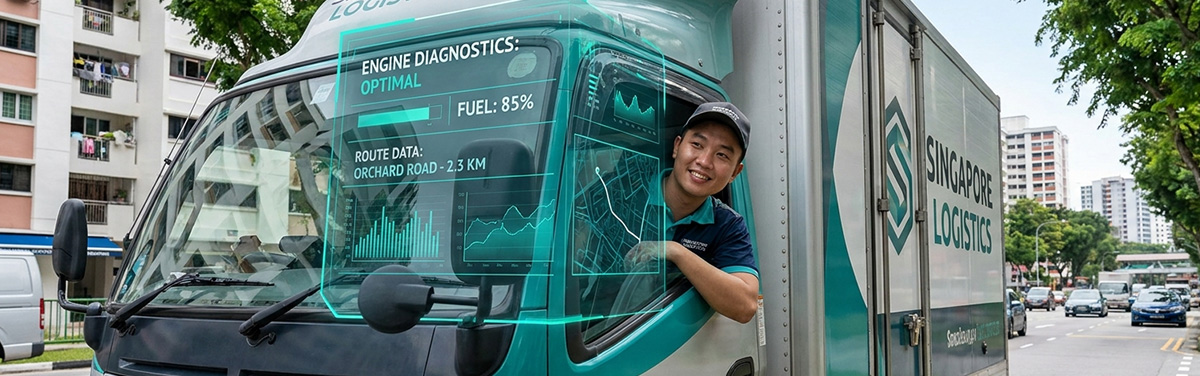
With resilient M2M connectivity, fleet vehicles can transmit continuous streams of data to a central control system in real time. This includes GPS coordinates, vehicle diagnostics, engine parameters, and fuel consumption.
This gives fleet managers immediate visibility into every vehicle in their network. Whether it is a breakdown, an unauthorised detour, or a delayed delivery, real-time tracking enables an immediate response that protects service reliability and customer satisfaction.
Loss of connectivity at a critical moment can directly impact operations and customer experience. That is why SPTel’s Multi-network M2M SIM solution delivers 3 mobile networks in 1 SIM, effectively mitigating these risks by providing automatic failover across Singapore’s major carriers, keeping your fleet visible and always connected.
IoT and Telematics: Comprehensive Vehicle and Cargo Visibility
Modern fleet operations rely on a range of IoT devices to track and monitor different aspects of vehicle and cargo performance. Each device type serves a specific purpose.
Vehicle Telematics and Real-Time Diagnostics
Vehicle telematics systems continuously collect data on engine performance, fuel consumption, maintenance intervals, and driving behaviour. This information enables fleet managers to move from reactive maintenance to proactive servicing.
When engine diagnostics are transmitted in real time, maintenance issues can be identified before they cause a vehicle breakdown. AI takes this further by analysing patterns in that data, such as engine wear, vibration signatures, and oil pressure trends, to predict faults days or weeks in advance. Fleet managers can then schedule servicing during off-peak hours, reducing unplanned downtime and improving overall fleet availability.
AI can also be used to analyse driver behaviour data collected through telematics. Patterns such as harsh braking, rapid acceleration, and cornering intensity are statistically linked to accident risk and insurance claims. Fleet managers can use this to identify high-risk drivers and deliver targeted safety coaching. Real-time in-vehicle alerts and post-trip reviews improve driver accountability over time, reducing accident rates and associated costs.
Fuel efficiency monitoring adds a further layer of value. By identifying wasteful driving patterns and suboptimal routing, telematics data enables targeted coaching that can reduce fuel costs by 10 to 15%.
Cargo Monitoring and Route Optimisation
For fleets transporting perishable goods, pharmaceuticals, or sensitive equipment, IoT sensors can provide real-time monitoring of temperature, humidity, and physical handling conditions throughout the journey. This ensures regulatory compliance and reduces the risk of spoilage or damage.
On the routing side, IoT devices can continuously transmit vehicle location and movement. This data is fed into AI-powered route optimisation engines that analyse traffic patterns, congestion data, and delivery schedules to calculate the most efficient routes. The optimised routes are then pushed directly to drivers in real time. For multi-stop delivery vehicles, this directly reduces driving distance, fuel consumption, and delivery times, which matters greatly in Singapore’s competitive e-commerce environment.
Fleet Management Use Cases
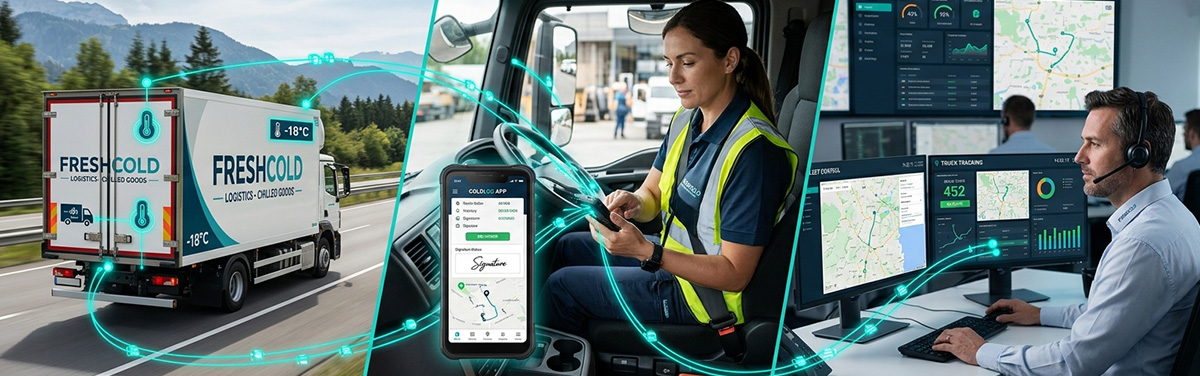
Here is a quick overview of how these capabilities can be combined for efficient fleet management:
- Real-time tracking: Delivery organisations monitor vehicle locations in real time, provide customers with accurate delivery updates, and respond immediately to traffic incidents or route changes.
- Fuel efficiency monitoring: Fleet managers use telematics data to identify wasteful driving patterns, coach drivers, and optimise routes, achieving fuel cost reductions of 10 to 15%.
- Driver behaviour analysis: Fleets with high insurance exposure use AI-powered driver coaching to reduce accident rates, lower premiums, and build a stronger safety culture.
- Maintenance scheduling: Predictive analytics identify servicing requirements days in advance, reducing unexpected breakdowns and keeping vehicles on the road.
- Cold chain logistics: Temperature-controlled fleets use IoT sensors to monitor cargo conditions throughout transit, ensuring compliance with regulatory requirements for pharmaceutical and perishable goods transport.
Here’s How You Can Achieve Efficient Fleet Management with SPTel

Running a smart fleet means managing many moving parts. Different IoT devices, different connectivity protocols, and different data streams all need to work together seamlessly, supported by resilient connectivity. SPTel provides two distinct solutions that address these needs at different levels.
SPTel’s Multi-Network Network M2M SIM: Reliable Connectivity for Every Device
Every IoT device in your fleet needs a reliable connection to transmit data. SPTel’s Multi-Network M2M SIM (3 networks in 1 SIM) is your reliable connectivity solution. It ensures automatic failover across Singapore’s major carriers, so vehicle tracking and data transmission remain uninterrupted even if a primary network goes down.
For Singapore-based fleets operating across ASEAN and international markets, the SIM also supports global roaming with seamless handoff between local and overseas networks, keeping operations connected wherever they run.
The Multi-Network M2M SIM is a connectivity solution. It keeps your IoT devices online. How you manage these IoT devices and the data generated is where SPTel’s IoT-as-a-Service platform comes in.
SPTel’s IoT-as-a-Service Platform: One Platform for All Your Fleet’s IoT Devices
SPTel’s IoT-as-a-Service platform is a device management platform that connects all your fleet IoT devices into a single, unified dashboard, regardless of vendor or protocol. GPS trackers, cargo sensors, tyre monitors, and engine diagnostic tools can all report to one place, eliminating the data silos that slow down decision-making.
The platform is multi-protocol by design. Whether your sensor connects with LoRaWAN for wide-area coverage, 4G/5G for high-bandwidth telematics, or Wi-Fi for fixed asset tracking, the platform will be able to aggregate all your connected sensors and data for simplified management. This means fleet operators are not locked into a single connectivity type or device ecosystem. Different sensor types can be deployed for different use cases and managed from one central platform.
With SPTel’s IoT Platform delivered “as-a-Service”, there is no heavy initial capital outlay required. As fleet operations grow with new vehicles, new regions, and additional sensor types, users can simply add more devices to the platform as needed.
Driving Competitive Advantage Through Smart Fleet Operations

Singapore’s logistics industry is expanding rapidly, and the expectations placed on fleet operators are rising with it. Manual processes and single-carrier connectivity are no longer sufficient to meet the demands of modern time-sensitive freight operations.
The combination of Multi-Network M2M SIM connectivity, IoT telematics, and AI-powered analytics gives fleet managers the tools to reduce costs, improve service quality, and make faster, more informed decisions. But these tools are only as effective as the platform that brings them together.
With SPTel, you can build a connected fleet that performs reliably, scales with your business, and keeps your logistics operations running efficiently. Contact our experts today to explore smart fleet management solutions tailored to your organisation.