

How IoT is Transforming Healthcare in Singapore: A 2026 Update
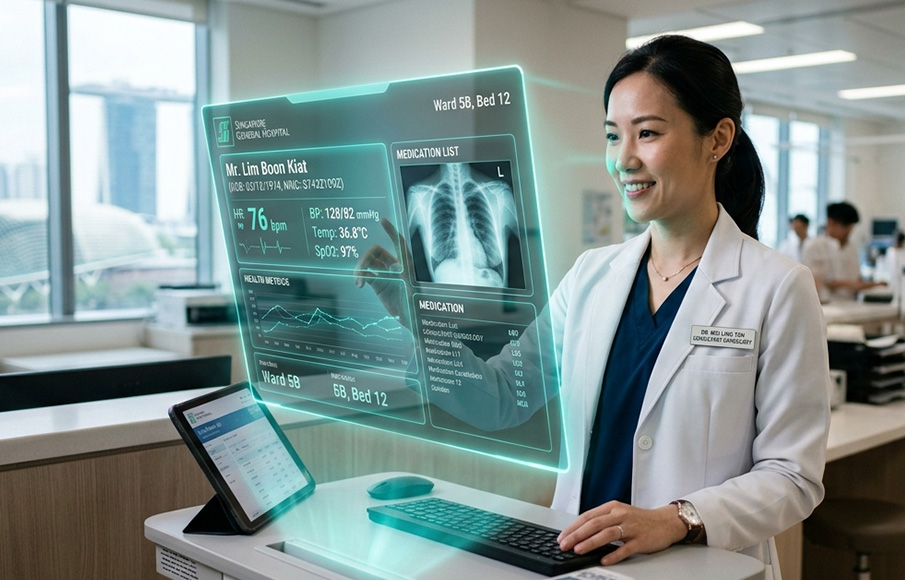
Singapore’s healthcare system is under growing pressure. In 2025, 20.7% of citizens are aged 65 and above, a figure projected to rise to 23.9% by 2030. At the same time, the Ministry of Health projects a need for 15,000 additional healthcare professionals by 2030, with nursing vacancy rates already sitting at 12%.
IoT adoption is helping bridge this gap. Healthcare organisations report average operational cost reductions of 26%. The global IoT healthcare market underscores this momentum, valued at USD 65.03 billion in 2025 and projected to reach USD 368.06 billion by 2034.
This article explores the key IoT trends reshaping Singapore’s healthcare sector, the challenges organisations face in deployment, and how SPTel’s IoT-as-a-Service platform enables System Integrators to deliver reliable, scalable healthcare IoT solutions.
Three Key IoT Trends Reshaping Healthcare in Singapore

Trend #1: Remote Patient Monitoring and Wearable Integration
RPM has become standard practice in Singapore’s healthcare system. Hospitals have adopted remote clinical monitoring programmes such as Mobile Inpatient Care-at-Home (MIC@Home), enabling continuous virtual care beyond the hospital ward. Singapore has also established itself as the dominant market for medical wearable devices in Southeast Asia, recognised as an early adopter integrating wearables directly into clinical workflows and RPM programmes.
IoMT-enabled programmes have achieved measurable clinical outcomes, including a 57% decrease in asthma exacerbations for patients under connected care. The global smart wearables market is growing at a CAGR of 7%, reflecting sustained demand for connected monitoring devices. As wearables become more sophisticated, their integration with hospital systems is enabling a more continuous, data-driven approach to patient care.
Trend #2: AI-Enabled Predictive Analytics and Anomaly Detection
AI integration with IoT is enabling a shift from reactive to preventive care. Rather than responding to emergencies, healthcare teams can now support clinical risk stratification and early intervention before conditions deteriorate.
Singapore’s Ministry of Health is leading this push. Initiatives such as the AI Medical Imaging platform (AIM.SG) and the National Analytics Platform are laying the groundwork for AI-driven healthcare at a national level. AI-powered video analytics can also detect anomalies in patient behaviour and flag unauthorised access to critical areas in real time.
Trend #3: Increased Digitalisation in Healthcare Driving Need for Interoperability
Healthcare organisations are deploying more and more diverse sensor ecosystems to support various caregiving functions. This has made flexible, multi-protocol connectivity more important than ever to effectively operate at scale.
Devices within care facilities typically rely on LoRaWAN or Wi-Fi for wide-area, low-power monitoring. Mobile devices that move beyond the building, such as wearables used in community care, may require 4G or 5G connectivity to maintain reliable data transmission.
National digitisation of the healthcare sector is also accelerating. The Ministry of Health is rolling out automated record updating across the public healthcare system by end of 2025, reinforcing the need for interoperable systems as well as always-on connectivity.
Why Adopt IoT for Healthcare: Singapore’s Systemic Challenges

The number of Singaporeans aged 80 and older has surged 60% in the past decade, reaching 145,000 in June 2025. IoT-enabled monitoring helps extend the reach of a constrained healthcare workforce. With nursing vacancy rates at 12% and a projected shortfall by 2030 of 15,000 professionals, IoT automation reduces the manual burden on care teams, allowing staff to focus on higher-value clinical tasks.
Automated IoT systems also reduce manual data entry errors and create time-stamped audit trails that support compliance and clinical governance.
Beyond workforce efficiency, proactive IoT monitoring enables early detection and preventive care, reducing costly emergency admissions. Asset tracking further cuts capital waste across facilities.
Challenges in IoT Healthcare Deployment
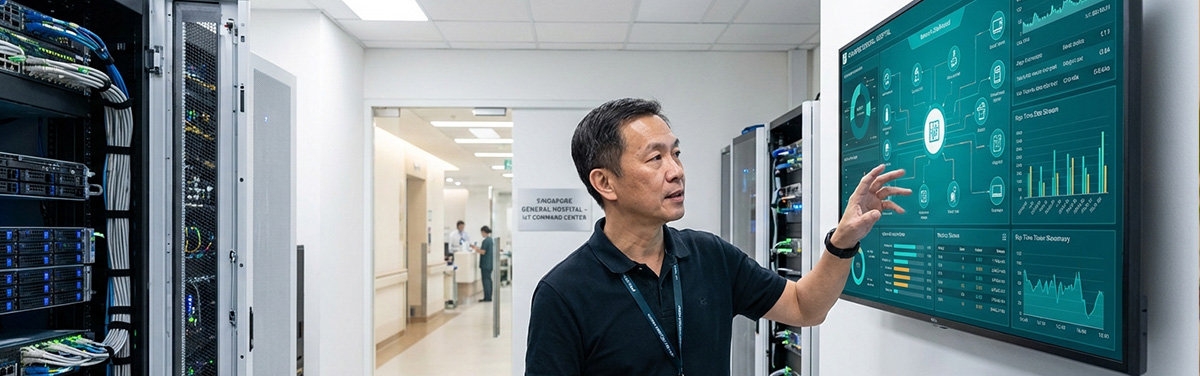
Scalability
Growing sensor ecosystems bring diverse protocols, power requirements, and update schedules, all of which demand flexible, unified device management platforms. Future-proofing is equally critical. Deployments must accommodate new connectivity types such as 5G and proprietary protocols as they emerge.
Reliable Connectivity
Complex hospital environments, including operating theatres, shielded rooms, and areas with structural obstacles, require robust connectivity with automatic failover. For time-critical monitoring such as cardiac and blood pressure tracking, any connectivity gap can directly compromise patient safety.
Deployment Speed
Healthcare institutions need rapid deployment to minimise clinical disruption whilst meeting regulatory compliance requirements. Custom-built infrastructure lengthens timelines and increases capital expenditure, delaying time to value.
Device Manageability at Scale
Managing thousands of connected devices requires remote monitoring, firmware updates, and centralised oversight across a unified platform. Without this, organisations risk data silos that hinder visibility and decision-making.
Deploying devices across multiple platforms compounds this problem. A consolidated device management platform aggregates data into a single dashboard, enabling better insights and more efficient management across the entire deployment.
SPTel’s IoT-as-a-Service: Built for Healthcare Connectivity
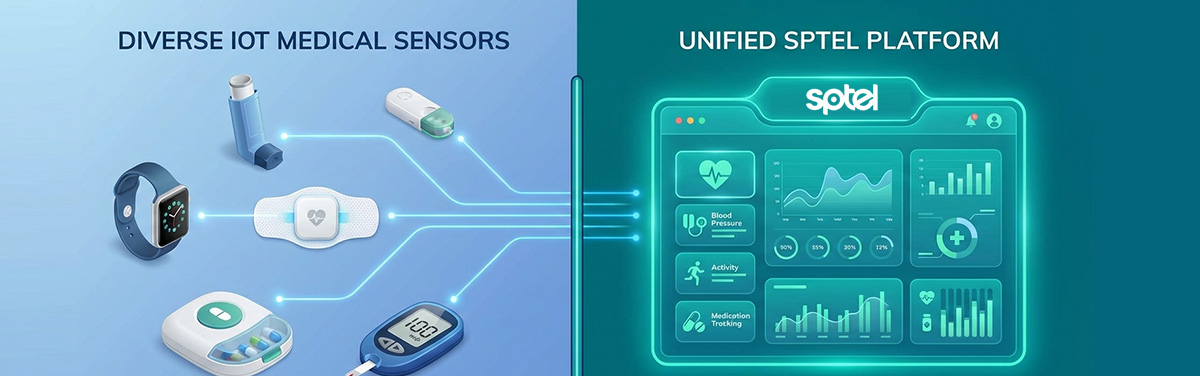
SPTel’s IoT-as-a-Service is designed for System Integrators deploying IoT solutions on behalf of healthcare organisations. Here is how each component addresses real deployment challenges.
Multi-Protocol Platform: One Platform, Any Sensor
SPTel’s platform supports LoRaWAN, NBIoT, 4G, 5G, and Wi-Fi simultaneously. System Integrators can onboard any sensor type without platform constraints, and a single unified dashboard manages all connected devices, simplifying operations and reducing overhead across complex deployments.
LoRaWAN Sensor Network: Ready to Deploy
SPTel operates Singapore’s first LoRaWAN Sensor Network, removing the need for System Integrators to invest in gateway hardware and maintenance. Outdoor gateways are solar-powered and hosted within secure Critical Information Infrastructure (CII), supporting green, secure, and future-ready healthcare deployments.
System Integrators can go live immediately, leveraging existing infrastructure for faster time to value.
IoT-as-a-Service Platform: Ready-to-Use Subscription Platform
SPTel’s managed IoT-as-a-Service platform enables users to manage devices, perform data ingestion, cloud storage, set up analytics dashboards, and application APIs. Subscription-based pricing eliminates upfront investment, and System Integrators can scale simply by adding devices as needed.
Teams can focus on clinical application development rather than backend infrastructure management.
Multi-Network M2M SIM: Failsafe Connectivity for Critical Monitoring
SPTel’s Multi-Network M2M SIM automatically switches between Singapore’s three major telecommunications operators, ensuring uninterrupted connectivity for critical patient monitoring. When a mobile network goes down, automatic failover to the next available mobile carrier protects time-sensitive applications such as cardiac monitoring, fall detection, and blood pressure tracking from connectivity gaps.
The solution also supports global deployments with resilient global 4G/5G connectivity, enabling healthcare organisations to extend IoT solutions internationally with automatic network selection.
Use Case for Local Healthcare: NEHR and Healthier SG enabled by SPTel IoT, Edge Cloud and Fibre

Singapore’s Ministry of Health is shifting healthcare from a hospital-centric model to one that is preventive, decentralised, and community-based. Driven by Healthier SG and the National Electronic Health Record (NEHR), the goal is to bring care closer to patients while reserving hospitals for critical care.
Care Anywhere, Not Just in Hospitals
Healthcare providers such as the National Healthcare Group (NHG) are already enabling mobile diagnostics including X-ray and ultrasound, community and GP-led care, and home-based monitoring. This allows patients to receive care near home or on the move, reducing unnecessary hospital visits.
The Challenge: Massive, Distributed Healthcare Data
Decentralised care generates significant data demands. Large imaging files from radiology and pathology, continuous monitoring data, and cross-location data sharing such as teleradiology all need to flow quickly and securely into NEHR. Without the right infrastructure, this leads to latency, congestion, and fragmented care.
With the right partner to support data collection and transmission, this can be made possible. SPTel can enable this transformation through three integrated layers.
1. IoT: Data from Anywhere
Supported by SPTel’s IoT-a-a-S platform, wearables, home monitoring devices, and mobile diagnostic equipment can enable continuous collection of patient data wherever patients may be, supporting preventive and proactive care.
2. Edge Cloud: Real-Time Intelligence
For responsive local processing of imaging and clinical data for faster diagnostics and alerts, healthcare organisations can choose to use SPTel’s low latency edge cloud to support efficient data transfer to NEHR. This allows for real-time decision-making and scalable data handling.
3. Fibre Network: High-Performance Connectivity
Added resiliency can be achieved for the entire solution with SPTel’s diverse and resilient fibre network that runs along the power grid. This reduces the chances of outages on shared infrastructure affecting critical services. Supported by an ultra-low core network latency of <1ms islandwide, SPTel’s network is built for critical healthcare applications, delivering fast, reliable, and secure data movement nationwide.
Use case for Elderly Care: Showcasing the strength of IoT-a-a-S

A nationwide wireless alert button project for seniors demonstrates how IoT can address real healthcare needs at scale. The solution allows elderly residents to call for help instantly, with alerts routed to nearby care centres.
SPTel’s LoRaWAN Sensor Network is well-suited for this type of deployment. Wide-area coverage and on-premise indoor gateways managed by SPTel mean IoT providers can focus on rollout without worrying about connectivity infrastructure, enabling rapid deployment across multiple locations around the island. A unified device management platform enables care coordinators to monitor connectivity and respond promptly to alerts.
This type of deployment reflects the broader potential of IoT in community healthcare. Learn more about SPTel’s Smart Nation IoT initiatives.
Use Case for Healthcare Applications: Edge Cloud for Time-Critical Healthcare Applications

Why Latency Matters in Healthcare
Applications such as arrhythmia detection, anomaly-based alert triggering, and patient behaviour analysis require ultra-low latency processing to function reliably. Edge-based monitoring systems reduce data transmission latency by 68% compared to cloud-centric approaches, whilst maintaining accuracy.
SPTel’s Edge Cloud Solution
SPTel operates distributed edge cloud nodes within secure CII facilities across Singapore, enabling processing within milliseconds of data sources. Edge deployments achieve an 87.3% reduction in data transfer latency versus cloud-only architectures.
Sensitive patient data is processed locally, without traversing wide-area networks, supporting data sovereignty and regulatory compliance.
Clinical Benefits
Patients benefit from a higher standard of care. Real-time biometric monitoring and anomaly detection enable timely clinical intervention, reducing the risk of preventable adverse events.
For care teams, automated alerts and remote monitoring reduce manual workloads, allowing healthcare staff to focus on direct patient care rather than routine data collection. This helps ease the strain on an already stretched workforce.
Conclusion

Singapore’s healthcare sector faces mounting pressure from demographic ageing, workforce shortages, and rising patient demand. IoT technology is key to addressing these challenges at scale.
Remote patient monitoring, AI-driven analytics, and multi-protocol connectivity are reshaping how care is delivered across Singapore. To deploy these solutions effectively, System Integrators need infrastructure that is reliable, scalable, and fast to implement.
SPTel’s integrated IoT-as-a-Service platform provides exactly that: a multi-protocol device management platform, a ready-to-use nationwide LoRaWAN Sensor Network, M2M Multi-Network SIM for critical reliability, and Edge Cloud for ultra-low latency processing.
With SPTel, System Integrators can deploy faster, scale with confidence, and focus on clinical innovation without the burden of building and managing IoT infrastructure.
With SPTel, you can deploy healthcare IoT solutions with confidence. Explore SPTel’s healthcare solutions or learn more about SPTel’s IoT-as-a-Service platform and contact our specialists to discuss your requirements.