
What Is Wi-Fi 7? Key Benefits for Businesses in 2026
Wi-Fi 7 has quickly become the leading choice for organisations upgrading their wireless networks. It builds on Wi-Fi 6 with wider channels, faster speeds, and lower latency.
Enterprise adoption is accelerating. According to IDC, Wi-Fi 7 accounted for 44.5% of enterprise WLAN access point revenue in the first quarter of 2026, up from 11.8% a year earlier. This makes it the leading generation of Wi-Fi being deployed by organisations today.
For businesses still running on Wi-Fi 6, understanding what Wi-Fi 7 offers, and why the shift is happening so quickly, is useful for planning your next network upgrade.
This article covers what Wi-Fi 7 is, its key benefits, and how businesses in Singapore can adopt it with SPTel’s Managed Wi-Fi 7 solutions.
What is Wi-Fi 7?
Wi-Fi 7 is the latest wireless network technology designed to offer faster speeds, better reliability, and the ability to support more devices than previous Wi-Fi standards. It supports a wider bandwidth and has reduced latency, which is great for high-demand applications.
Wi-Fi 7 is the next-generation wireless standard offering faster speeds, lower latency, and higher capacity than Wi-Fi 6. Key benefits include 320 MHz ultra-wide channels, 4K QAM for increased data rates, and Multi-Link Operation (MLO) for improved reliability, making it ideal for AR/VR, 4K/8K streaming, and ultra-responsive applications.
Is Wi-Fi 7 Available in Singapore Now?
Yes, Wi-Fi 7 is already available in Singapore, with many local service providers such as SPTel offering Managed Wi-Fi solutions featuring the technology, along with a comprehensive end-to-end management service. For businesses, tapping on these services means they can free up their IT teams to focus on other critical tasks while the service providers handle the complexities of network administration and maintenance—such as configuring corporate and guest Wi-Fi.
What are the Benefits of Wi-Fi 7?
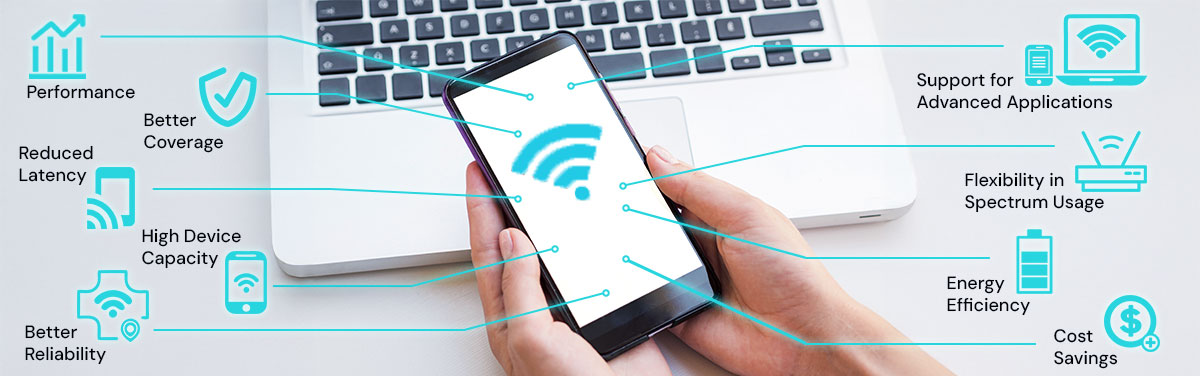
These are the benefits that make Wi-Fi 7 superior to previous generations:
1. Enhanced Speed and Performance for Modern Applications
Wi-Fi 7 delivers up to 46 Gbps throughput—more than four times faster than Wi-Fi 6—empowering businesses to run data-heavy applications like 4K/8K video conferencing, cloud collaboration, and AI tools with seamless efficiency. This performance leap eliminates network bottlenecks, allowing staff to work faster and more productively.
Unlike previous Wi-Fi generations, which support only 1024-Quadrature Amplitude Modulation (QAM)—a method that combines multiple signals into a single channel—Wi-Fi 7 offers 4096-QAM. This higher modulation allows for more efficient data transmission rates.
With enhanced data density, improved transmission efficiency, wider channels, and the ability to use multiple bands and channels simultaneously, Wi-Fi 7 can deliver speeds up to four times faster than Wi-Fi 6 and six times faster than Wi-Fi 5.
For businesses reliant on real-time communication, such as video calls or streaming events, this improved performance can be a game-changer.
2. Better Coverage and High Device Capacity
Wi-Fi 7 introduces several key advancements, with enhanced coverage being one of the most notable. It delivers strong, reliable signals even over larger areas like office buildings, warehouses, and campuses. This eliminates dead zones and ensures smooth operations across the entire area.
Wi-Fi 7 is also able to operate on a tri-band radio spectrum—2.4 GHz, 5 GHz, and 6 GHz. Combined with an increase in MU-MIMO streams, a technology that uses multiple antennas to create simultaneous connections to the same device, from 8 to 16, Wi-Fi 7 can handle more devices and greater data traffic without sacrificing performance.
But that’s not all. Wi-Fi 7 also features Multi-Link Operation (MLO), which lets devices use multiple radio brands simultaneously for data transmission. This reduces network interference and congestion while delivering extremely high throughput and lower latency.
With Wi-Fi 7, you’ll never have to worry about weak and intermittent connections in crowded areas with multiple devices and users.
3. Greater Reliability and Lower Latency for Critical Operations
With new features like Multi-Link Operation (MLO), Wi-Fi 7 enables simultaneous data transmission across multiple bands, reducing latency and ensuring consistent performance—even in congested environments. This is crucial for industries like healthcare, manufacturing, and finance, where real-time data and uptime directly impact operations and revenue.4. Energy Efficiency
Beyond delivering high performance, Wi-Fi 7 is also designed to enhance energy efficiency. This focus on reducing power consumption is especially important for businesses deploying large numbers of connected devices, such as wireless sensors and mobile devices, where extending battery life and optimising power use is critical.
One of the Wi-Fi 7’s key power-saving features is the Target Wake Time (TWT), which was also first introduced in Wi-Fi 6. It allows devices to schedule specific times to wake up and communicate with the network, which means that there’ll be less energy-draining communication throughout the day.
Wi-Fi 7 takes this step further by optimising the coordination between devices and access points. Devices are able to “sleep” for longer periods and wake only when necessary. For businesses using IoT sensors or mobile devices, these enhancements mean longer-lasting batteries and lower maintenance costs, as devices don’t need to be recharged or replaced as frequently.
The MLO feature, which allows devices to operate on multiple frequency bands, also minimises the energy needed to maintain stable connections—it dynamically selects the optimal band and link based on network traffic, interference, and device conditions. This is particularly beneficial in environments with varying signal quality, such as factories or large offices with multiple access points.
5. Cost Savings
Wi-Fi 7 and its advanced features provide increased capacity and improved functionality without the need for costly upgrades or extra infrastructure. Why is that the case?
First off, its enhanced efficiency lets you accommodate more users and devices with the same network configuration—no need for more access points or switches even in high-density settings.
Its increased data speed and reduced latency also improve productivity and user experience without requiring further network optimisation tools. This faster and more reliable network means lower support and downtime costs.
By making the most out of your existing devices, you can extend the life cycle of your hardware investments and eventually save on capital expenses.
6. Future-Proofing and Capacity for Growing Connectivity Demands
Wi-Fi 7 supports wider 320 MHz channels, 4K QAM, and up to 16 spatial streams, enabling higher user density without compromising performance. As more IoT devices, remote users, and digital workloads enter your network, upgrading now ensures your infrastructure can scale securely, efficiently, and without costly retrofits later.
Is Wi-Fi 7 Better than Wi-Fi 6?

Yes, Wi-Fi 7 is better than Wi-Fi 6 in multiple aspects. Wi-Fi technology has evolved significantly over the years, with each iteration bringing enhancements that cater to the growing demands of users and devices. While Wi-Fi 6 introduced a host of improvements in wireless connectivity, Wi-Fi 7 takes these advancements to the next level.
- Speed: Speed is one of the most significant upgrades in Wi-Fi 7. It promises speeds that are over four times faster than Wi-Fi 6, which can greatly enhance productivity in environments that require high data throughput. You can expect smoother video calls, faster downloads, and an overall improved online experience.
- Bandwidth: With Wi-Fi 7, you can obtain double the bandwidth of Wi-Fi 6, allowing more data to be transmitted at the same time. This reduces congestion and ensures that devices can operate more efficiently without affecting each other’s performance.
- Latency: For applications that require immediate feedback, such as gaming and online meetings, latency is a critical factor. Wi-Fi 7 offers reduced latency and faster data transmission, making it an ideal choice for time-sensitive applications.
- Backward Compatibility: Both Wi-Fi 6 and Wi-Fi 7 are backwards compatible. This means that they allow older devices to connect to the new network without issues. You’ll be able to upgrade your infrastructure and enjoy faster speeds without replacing all your devices.
As an advancement in internet technology that is superior in all four of these ways, Wi-Fi 7 can be conclusively regarded as a direct improvement to Wi-Fi 6.
Introducing SPTel’s Managed Wi-Fi (Wi-Fi 7)

Unsure how to set up a Wi-Fi 7 router? Leave it to SPTel. As an industry professional in Internet technology, we offer Managed Wi-Fi services that allow companies to focus on their business needs without worrying about infrastructure setup and technical knowledge.
Our comprehensive end-to-end services include the management and deployment of low-latency Wi-Fi 7 devices supported by an ultra-low latency network (<1ms) to fully maximise the performance of your connected applications.
Ultra Low Latency Through Edge Cloud Computing
Wi-Fi 7 Applications connected to SPTel’s low latency network can also achieve a high level of responsiveness through our Edge Cloud (up to 10x more responsive than public cloud), which decreases latency with compute resources closer to the source of data. This form of cloud computing processes information locally, at the edge of the network, instead of using a centralised data centre or cloud.
Business Class Software Defined Network
To ensure maximum uptime for your connected Wi-Fi 7 devices, SPTel utilises a robust Business Class Software Defined Network, that’s built on physically diverse infrastructure from other providers. As a software-defined solution, this network allows for flexible, scalable, and efficient management of your internet needs. Through the use of the customer portal, users can seamlessly explore product offerings and flex their bandwidth-on-demand in the instance of network congestion.
End-to-end Quality of Service
SPTel’s Wi-Fi 7 combined with edge cloud solution delivers a future-ready network experience with ultra-low latency and end-to-end Quality of Service (QoS). Leveraging SPTel’s best-in-class, lowest-latency network in Singapore, this integrated offering ensures seamless, high-performance connectivity for both wired and wireless devices. This is ideal for mission-critical, latency-sensitive applications such as smart manufacturing, AI workloads, and real-time analytics. With edge compute positioned closer to users and devices, businesses benefit from faster response times, improved data security, and reduced backhaul traffic.
Achieving Efficient Business Connectivity With SPTel
SPTel’s Managed WiFi solution delivers Wi-Fi 7 with end-to-end QoS via an ultra-low latency, scalable and resilient network. Coupled with our Edge Cloud customers can look forward to faster, more responsive application performance.
Our Managed Wi-Fi 7 services are especially beneficial for:
- Small businesses that lack the resources for in-house network management
- Multi-site enterprises that require consistent network performance across locations
- Retail businesses that need seamless Wi-Fi for customer engagement
- Large venues or campuses requiring reliable connectivity for numerous users
- Healthcare facilities looking for secure, scalable Wi-Fi for dealing with sensitive data
Future-proof your business and enjoy the cutting-edge benefits of this next-generation technology by contacting us today.