
Wi-Fi 7 vs 5G: Why Singapore Businesses with Digitalised Operations Need this Next-Generation Connectivity

Wi-Fi 7 adoption is accelerating rapidly. Global device shipments are projected to reach 583 million by the end of 2025, growing to 1.1 billion in 2026. The market itself is forecast to expand from USD 1.28 billion in 2024 to USD 8.94 billion by 2029, at a CAGR of 47.32%.
Enterprise adoption is gathering momentum as well. Wi-Fi 7 revenue share reached 31.1% of the dependent AP segment in Q3 2025, up from 21.0% in the previous quarter. Gartner forecasts that 70% of enterprises refreshing or expanding their wireless LAN will upgrade to Wi-Fi 7 by 2027.
Wi-Fi 7 vs Wi-Fi 6: A Significant Performance Leap

Speed
Wi-Fi 7 has a theoretical maximum speed of 46 Gbps, compared to Wi-Fi 6’s 9.6 Gbps. In real-world conditions, mobile devices on Wi-Fi 7 achieve speeds of 2-5 Gbps, versus 700 Mbps to 1 Gbps on Wi-Fi 6. Channel bandwidth has also doubled, with Wi-Fi 7 supporting 320 MHz channels compared to Wi-Fi 6’s 160 MHz.
Reliability
Wi-Fi 7 operates across three bands: 2.4 GHz, 5 GHz, and 6 GHz, one more than Wi-Fi 6. It automatically switches across all three bands to maintain signal reliability. The addition of 6 GHz spectrum unlocks up to 1,200 MHz of unlicensed spectrum, delivering up to three times the Wi-Fi capacity.
Latency
Wi-Fi 7’s Multi-Link Operation (MLO) achieves latency as low as 2 milliseconds. Compared to Wi-Fi 6, MLO delivers up to a 25% latency reduction and a 2.66x delay reduction when operating across multiple channels simultaneously.
Network Slicing: Predictable Performance for Critical Applications

The network slicing market is valued at USD 1.30 billion in 2025 and is projected to reach USD 2.81 billion by 2030. The enterprise segment is the fastest-growing, with a CAGR of 52.9%.
How Network Slicing Works
For example, with a 1 Gbps IPVPN line, an organisation can reserve 500 Mbps for mission-critical applications while allocating the remaining 500 Mbps for general office use.
This ensures consistent, guaranteed performance for essential services, regardless of overall network traffic.
Why Wi-Fi 7 Is an Alternative to Private 5G for Singapore Businesses
For businesses running unmanned automation operations such as AGV-guided warehouses, robotic assembly lines, or smart factory floors, Wi-Fi 7 presents a viable alternative to private 5G. Within these fixed indoor environments, it can deliver comparable performance at significantly lower cost and complexity. Here is why.
Licensing and Spectrum
In Singapore, the Infocomm Media Development Authority (IMDA) only grants 5G spectrum licences to local telcos. This means businesses looking to deploy a 5G private network must purchase access through those providers. The base price for a Singapore 5G nationwide network stands at SGD 55 million. Annual usage fees for 100 MHz at the 3.5 GHz band are SGD 154,000, while mmWave spectrum (800 MHz, 26/28 GHz) costs SGD 1.23 million per year.
Wi-Fi 7, by contrast, operates on an unlicensed band. There are no spectrum access fees.
Deployment Speed and Simplicity
Wi-Fi 7 is faster to deploy. Installing an access point with a connection is all that is needed to get operational. A 5G private network requires one radio unit to cover the equivalent area of 10-20 Wi-Fi access points. Where existing Wi-Fi infrastructure is already in place, Wi-Fi 7 also offers a lower total cost of ownership.
Device Compatibility
Wi-Fi 7 supports a broader range of compatible devices than 5G. Wi-Fi 7-enabled devices are projected to reach 2.1 billion by 2028. Importantly, 60% of enterprise organisations already view Wi-Fi and 5G as complementary technologies, not competing ones.
When to Choose Wi-Fi 7 vs 5G

Wi-Fi 7 is ideal for:
- Operations contained within a specific location, such as office buildings, factories, warehouses, or campuses
- Indoor environments requiring high bandwidth and low latency
- Organisations seeking to avoid private 5G spectrum licensing costs
5G is better suited for:
- Wide-area or cross-border operations requiring mobility
- Outdoor deployments with seamless handover needs
- Use cases requiring carrier-grade reliability across large geographic areas
Wi-Fi 7 Enterprise Use Cases
Manufacturing and Industry 4.0
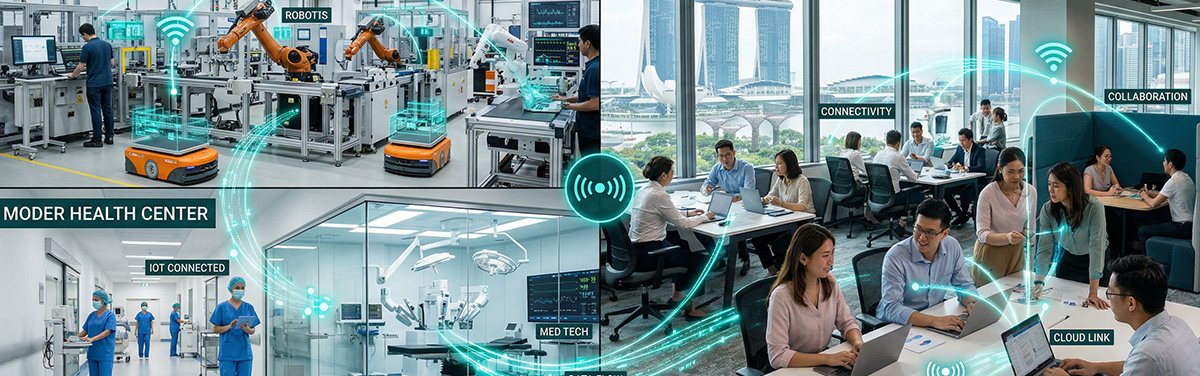
Wi-Fi 7 is well suited for smart factories, IoT devices, robotics, and RTLS. Automated Guided Vehicles (AGVs) and Automated Mobile Robots (AMRs) both benefit from deterministic, low-latency connectivity. Singapore’s robot density stands at 605 robots per 10,000 employees, second globally after South Korea, underscoring how relevant this capability is locally.
Extended Reality and AI Applications
Mission-critical XR applications for training and collaboration require consistent, high-bandwidth connectivity. AI workloads are projected to represent 50% of enterprise data traffic by 2026, up from 15% in 2021. Enterprise network traffic from AI scaling is expected to increase by 30-50% within two years.
Real-Time Monitoring and Analytics
Wi-Fi 7 supports smart factory operations with IoT sensors, real-time video analytics, and healthcare applications requiring mission-critical connectivity, all of which demand reliable, low-latency wireless infrastructure.
The SPTel Difference: Wi-Fi 7 with End-to-End QoS

Pre-Configured Network Slicing
SPTel’s Wi-Fi 7 solution comes pre-configured for network slicing. This means easier network segmentation without complex setup, and reserved bandwidth for mission-critical applications from day one.
End-to-End Quality of Service Assurance
SPTel provides end-to-end Quality of Service (QoS) assurance. The network slice extends from the core network all the way down to the end device. It can also be complemented by SPTel’s Edge Cloud solution, extending the network slice to your compute resources for optimised performance at every level.
Lifecycle Management with PatchSense AI
SPTel’s managed service includes lifecycle management of Wi-Fi 7 devices, ensuring timely firmware updates and routine maintenance. This is supported by the PatchSense AI dashboard, which delivers vulnerability insights and proactive security monitoring, without the need for a dedicated in-house security team.
Multi-Link Operation: The Key to Wi-Fi 7 Reliability
MLO is one of Wi-Fi 7’s most significant advancements. It reduces average delay by 69-62% and cuts 95th percentile delay by up to 78%. It can also potentially double throughput by allowing simultaneous operation across the 2.4 GHz, 5 GHz, and 6 GHz bands.
For businesses running latency-sensitive applications, MLO delivers the consistency that previous Wi-Fi generations could not.
Enterprise Wi-Fi 7 Adoption Timeline
Gartner forecasts that Wi-Fi 7 AP shipments will reach 10% of all Wi-Fi AP shipments in 2025. Meanwhile, 38% of organisations are planning rollouts in 2025-2026, and IDC forecasts that 50% of new enterprise-class dependent AP revenues will be Wi-Fi 7 by 2027.
Businesses that act now are better positioned to stay ahead.
Future-Proof Your Business Connectivity with Wi-Fi 7

Wi-Fi 7 represents a significant step forward in wireless connectivity speed. With speeds up to 46 Gbps and latency as low as 2 milliseconds, it delivers the performance that modern business operations demand.
For Singapore businesses with unmanned operations, Wi-Fi 7 offers a practical alternative to private without spectrum licensing costs or complex deployment requirements. Network slicing further ensures that mission-critical applications always receive guaranteed performance.
With SPTel, you can gain pre-configured network slicing, end-to-end QoS assurance, and AI-powered lifecycle management through a single managed solution. Whether you are upgrading from Wi-Fi 6 or evaluating your options against 5G, SPTel’s Wi-Fi 7 solution positions your business for the demands of AI workloads, real-time analytics, and Industry 4.0 operations.