
On-Premise vs Cloud Computing in 2026: Is There a Hybrid Alternative?

Are you an IT professional weighing the control of on-premise solutions against the flexibility of the cloud? The good news is, you do not have to choose.
The global cloud computing market reached USD 781.27 billion in 2025 and is projected to grow to USD 905.33 billion in 2026. Yet despite widespread cloud adoption, IDC reports that 49% of production workloads still run on-premise today, as cost overruns, data sovereignty concerns, and latency limitations continue to give organisations pause.
This article explores the pros and cons of both approaches, and introduces a powerful hybrid alternative: edge cloud. Here is what you will learn:
- On-Premise vs Cloud Solutions: A comparison of cost, scalability, security, and maintenance.
- The Hybrid Cloud Advantage: How edge cloud combines on-premise performance with cloud flexibility.
- Added Benefits For Your Business: How SPTel’s edge cloud solution addresses latency, data sovereignty, and IT management challenges.
Whether you are deploying latency-sensitive applications, managing multiple sites, or have growing IoT needs, this article will help you make informed decisions about your cloud infrastructure.
On-Premise vs Cloud Solutions
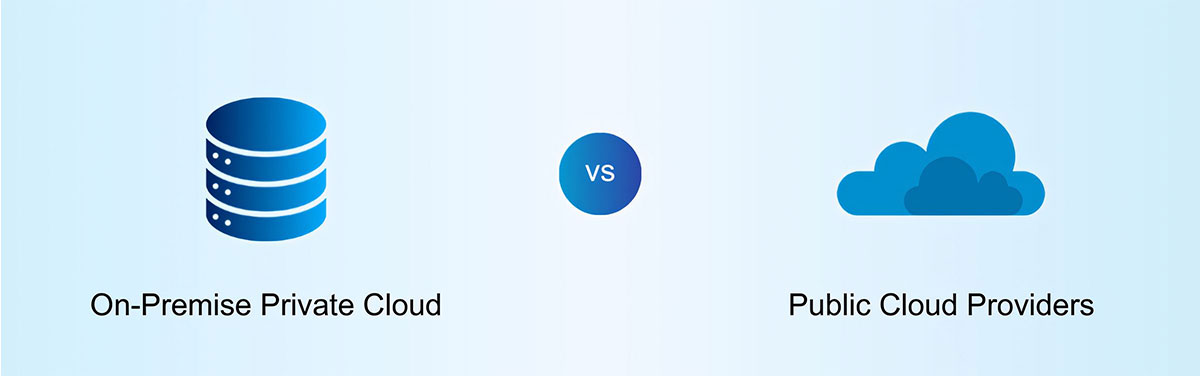
On-Premise Private Cloud
An on-premise cloud system is a type of cloud computing where the hardware and software that make up the cloud infrastructure are located within the organisation’s own data centre or office, rather than being hosted by a third-party cloud provider. This allows the organisation to maintain full control and ownership over the cloud environment.
| Pros | ||
| Full Control | Since you own the infrastructure when it comes to a private cloud, this allows for customisation with full access to control resource allocation, network settings, and software installation. | |
| Robust Security | Your IT team can ensure that resources are not shared with other businesses, and data is kept behind a firewall or other cybersecurity measures to reduce the risk of security breaches. | |
| Cons | ||
| Cost | When you manage on-premise infrastructure, this also means you are responsible for high capital expenditures (CAPEX) to acquire, maintain, and upgrade the physical facility. | |
| Need Ongoing Maintenance | Your equipment will require periodic refreshes and ongoing hardware maintenance, especially since IT infrastructure is subject to end of life (EOL), in which your equipment may become outdated/obsolete. | |
| Limited Scalability | On-premise systems will have a fixed resource capacity. This means purchasing more servers every time you want to scale your resources. | |
| Managed Expertise Required | You will require a skilled in-house IT team to manage networking, data security, and systems administration, on top of the hassle of overseeing multiple equipment. | |
| Potential Data Loss | Usually lacks backup and disaster recovery features that help prevent data loss due to hardware malfunctions, threats, or user errors. To prevent this, your IT team will have to perform back ups at an offsite location. | |
Public Cloud
A public cloud is a type of cloud computing where a third-party provider offers computing resources, such as storage, processing power, and software, over the internet. These resources are shared among multiple users, but each user’s data and applications are kept separate and secure.
| Pros | ||
| Cost-Effective | Cloud applications are often on a pay-as-you-go basis. Businesses also do not need to invest in infrastructure or specialised hardware and software upfront. | |
| Scalability | Public clouds are highly scalable, allowing businesses to easily increase or decrease resource usage based on their needs. | |
| Maintenance | The provider will handle maintenance tasks like software hosting, hardware purchases, security patches, updates, and new feature introductions. | |
| Cons | ||
| Higher application latency | There can be delays in application responsiveness, slower loading times and reduced performance. | |
| Surprise Costs | You may incur additional costs for chargeable partner services, data transfer, or if resource usage increases significantly. | |
| Security Concerns | Public clouds are shared infrastructures, raising security issues due to shared tools, hardware, and software. This poses risks for sensitive data and industries with strict compliance requirements. | |
The Alternative: Hybrid Cloud Solution

So far, we’ve covered on-premise and public clouds—and they both have their own benefits and drawbacks. Instead of forcing a choice between these two options, we present a more versatile solution: SPTel’s edge cloud computing solution, a hybrid approach that combines the strengths of both on-premise and public cloud models.
Here’s how our solution tackles common issues with on-premise & public cloud:
| Factor | Product Benefits |
| Cost |
|
| Scalability |
|
| Cost |
On top of that, we also diversify how your data is protected and where it is located. |
| Technical Expertise |
Read more: Top 5 Benefits of Outsourcing IT Support: Why Companies Do It |
Let Our Certified IT Experts Design, Deploy, & Manage Your Cloud

With SPTel Edge Cloud, you get the best of both worlds—the performance of an on-premise system combined with the flexibility and scalability of public cloud.
On top of that, here’s what our solution offers:
- Disaster Recovery: Multiple edge clouds that act as a backup for one another.
- Better Application Performance: Ultra-low latency of < 1ms with 4 edge zones distributed across Singapore
- Reduces IT Footprint: Eliminate the need to own, manage, and maintain physical equipment.
- Infrastructure-as-a-Service: On-demand access to powerful physical server infrastructure at predictable operational costs. Avoid the noisy neighbour effect from over resource virtualisation in a public cloud environment.
- Unified Cloud Management Portal: Manage your resources across multiple clouds via a single, unified self-service console.
For CTOs and IT managers, you can get more information about our Edge Cloud Computing Solution or reach out to us for any queries.