
Data Centre Interconnect Explained
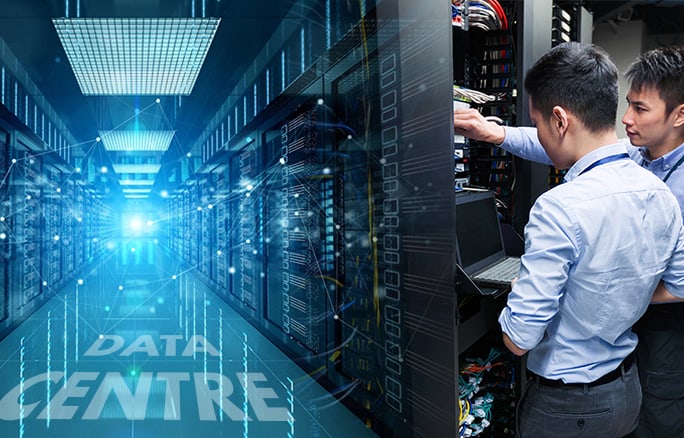
Businesses are generating, analysing, and storing greater amounts of data than ever before. This has driven growing reliance on Data Centre (DC) providers to manage and compute vast volumes of critical information. But while businesses focus heavily on choosing the right DC provider, it is equally important not to overlook the connectivity supporting the transmission of that data, especially when operations span multiple locations or cross global boundaries.
Data Centre Interconnect (DCI) is the technology that enables two or more data centres to be connected, regardless of distance, using high-speed packet-optical connections. The global DCI market was valued at USD 16.31 billion in 2025 and is projected to reach USD 18.73 billion in 2026, growing at a CAGR of 14.82% through 2035, according to Precedence Research. Growth is being driven by cloud adoption, AI workload migration, hyperscale data centre expansion, and the increasing demand for disaster recovery and business continuity solutions. Asia Pacific, which includes Singapore as one of the region’s leading data centre hubs, held a 35.1% revenue share of the global DCI market in 2024 and is the fastest-growing region globally.
Why is a Data Centre Interconnect service important for businesses? Find out more about DCI, its key benefits, and the factors to consider when choosing a provider.
What is Data Centre Interconnect (DCI)?
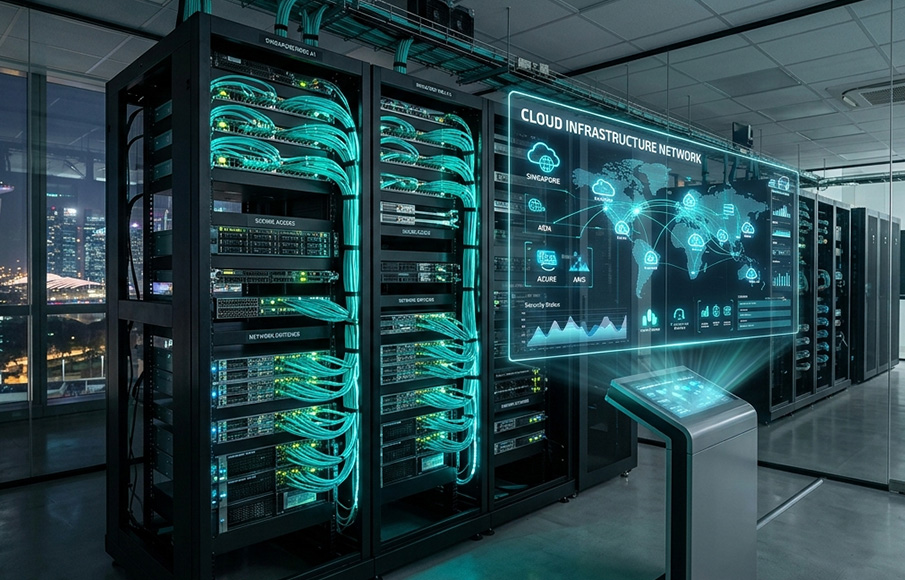
Data centre interconnect (DCI) is the technology that enables two or more data centres to be connected regardless of their distance with its high-speed packet-optical connections. DCI empowers businesses to connect with their clients locally and internationally without compromising security and connection performance.
Benefits of DCI services
Many businesses rely on DCs to provide their services to their customers. A reliable DCI solution that can support high-speed data transmission for optimized network traffic is therefore critical. DCI network services are also increasing in importance with today’s virtual ecosystem of online collaboration, learning and ecommerce, which has resulted in more data needing to be transmitted to DCs worldwide.
However, the question to ask is whether traditional DCI services can meet the resiliency and reliability standards of today’s business needs. To cater for maximum up time, DCI solutions need to evolve to include network self-healing capabilities to support automatic failover as needed. This will help organisations handle the unexpected without compromising on performance.
Things to know before engaging a DCI service

There are several factors to consider before engaging with a DCI service:
Diversity and Reliability – You need to question how reliable and resilient the underlying fibre infrastructure that supports your DCI connection is. SPTel connects most of Singapore’s major DCs using alternative fibre routes that are physically separate from the incumbents, providing for more resilient services. With dual exchanges supporting the DCs they connect, they can also deliver seamless auto-failover to maximise your service uptime.
Traffic routing – A good DCI service should be able to meet the needs of high traffic without compromising the speed and quality of the network.
Automation – This enables DCI operators to work with other applications to automate manually intensive tasks and simplify complex operations.
Ultra-low latency – Look for a provider that delivers an ultra-low latency connection to improve application responsiveness. SPTel’s 2-tier network structure is one such example which is differentiated from traditional 3-tier structures. It reduces the number of hops data needs to travel between points to deliver <1ms latency island-wide across the DCs they connect.
Flexibility – the best performing DCI service should be flexible whether is it for contract terms or with their reach. the best performing DCI service should be flexible especially with different coverage requirements that can range from global to international. This provides added flexibility for businesses to grow globally.
The Future of DCI Technology
DCI plays a large role in molding the future.

The requirements for DCI services will undoubtedly increase as more applications move to the virtual space. Key to supporting a robust DC strategy will be in ensuring your DCI partner has the capability to support you with a secure and reliable connection.
An example of a DCI solution that can keep up with the evolving demands is SPTel’s DCI Service. It brings users reliable and resilient network connectivity on a diverse fibre backbone to support Singapore’s network infrastructure demands. SPTel provides its customers with bandwidth options across multiple data centre locations in Singapore. Its reliable ethernet network comes with 24/7 monitoring by a Singapore-based Integrated Operations Centre (IoC) which combines network and security monitoring, for an unprecedented business class standard of care. Best of all, it comes with flexible contract terms that can start from 3 months and up so that you can better manage and plan for your resources.
SPTel’s DCI connectivity reach extends internationally with SPTel’s IDCI service. IDCI supports connectivity between multinational operations and data centres in Singapore that need to communicate with other centres across Asia, Australia, North & South America, Europe, Middle East, and Africa. The data centre interconnect solution is recommended for customers which are considering expanding their data centre operations overseas to acquire more audiences and to target international growth for their business.
In essence, SPTel’s DCI and IDCI solutions offer access to multiple DC providers, meaning both local and international customers have the option to further increase their network, securely and reliably, through SPTel’s business class digital network.
To know more about SPTel’s DCI services, click here.