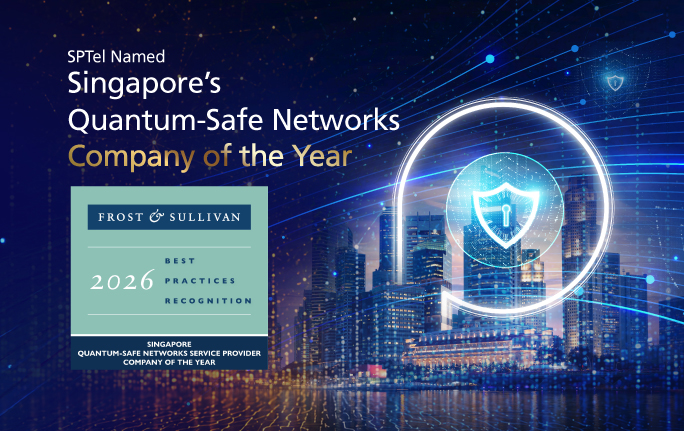

Quantum-Safe Cybersecurity: Preparing Your Network for the Future

Quantum computing represents one of the most significant cybersecurity challenges of the coming decade (Citigroup Institute, 2026), with Q-Day potentially arriving as early as 2030 (Palo Alto Networks).
Once executable at sufficient scale, Shor’s algorithm can efficiently factor large numbers, rendering RSA and elliptic-curve cryptography obsolete. This threatens the digital infrastructure underpinning financial transactions, government communications, and critical systems.
The threat is already active. Data encrypted today remains vulnerable to ‘harvest now, decrypt later’ attacks, where adversaries collect encrypted data now and decrypt it once quantum computers mature. This is a critical risk for organisations subject to data retention periods of seven to ten years or more.
How Fast are Quantum Computers?
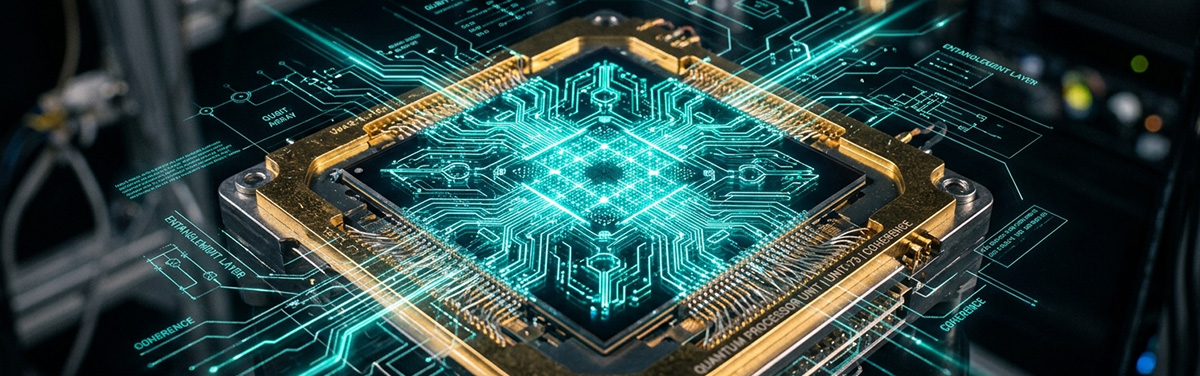
Quantum computers exploit quantum mechanics, specifically superposition and entanglement, to solve mathematical problems exponentially faster than classical computers. This fundamentally breaks current public-key cryptography (NIST).
IBM’s roadmap projects fault-tolerant quantum computers with hundreds of logical qubits by 2029. At that scale, breaking 1,024-bit RSA encryption could be feasible in hours or days.
Google’s Willow chip, released in December 2024, demonstrates exponential error reduction at scale. It can perform computations in five minutes that would require 10 septillion years on classical computers.
The Time to Act is Now

The NIST finalised three post-quantum encryption standards on 13 August 2024 (NIST):
- ML-KEM (FIPS 203) for key agreement
- ML-DSA (FIPS 204) for digital signatures
- SLH-DSA (FIPS 205) for digital signatures
ML-KEM and ML-DSA base their security on hard mathematical problems on lattices, which are resistant to quantum computer attacks.
The White House National Security Memorandum 10 (NSM-10) mandates that U.S. Federal systems complete their transition to quantum-safe cryptography by 2035, however the NIST recommends transitioning to post-quantum algorithms immediately.
Singapore’s Quantum Leadership and Business Implications

Singapore is emerging as a global frontrunner in operationalising quantum-safe networking, not just exploring it. Singapore’s National Quantum Strategy allocates S$300 million over five years across four strategic funding initiatives (National Quantum Office):
- Centre for Quantum Technologies (CQT)
- Quantum Engineering Programme 3.0 (QEP 3.0)
- National Quantum Processor Initiative (NQPI)
- National Quantum Scholarships Scheme (NQSS)
Building on over S$400 million invested in quantum research since 2002, Singapore is positioning itself as a regional quantum technology leader, attracting international partnerships and talent.
In 2024, MAS collaborated with DBS, HSBC, OCBC, UOB, SPTel, and SpeQtral to complete a quantum-safe communications proof-of-concept sandbox in the financial sector.
The sandbox findings confirmed that quantum key distribution (QKD) has the potential to strengthen network security and can secure connections between data centres and financial institution premises.
Singapore’s expertise in quantum technology creates competitive advantages for financial services, telecommunications, and critical infrastructure operators seeking quantum-safe security solutions.
SPTel’s Quantum-Safe Cybersecurity Solutions: Security at Every Level
Quantum Key Distribution (QKD)
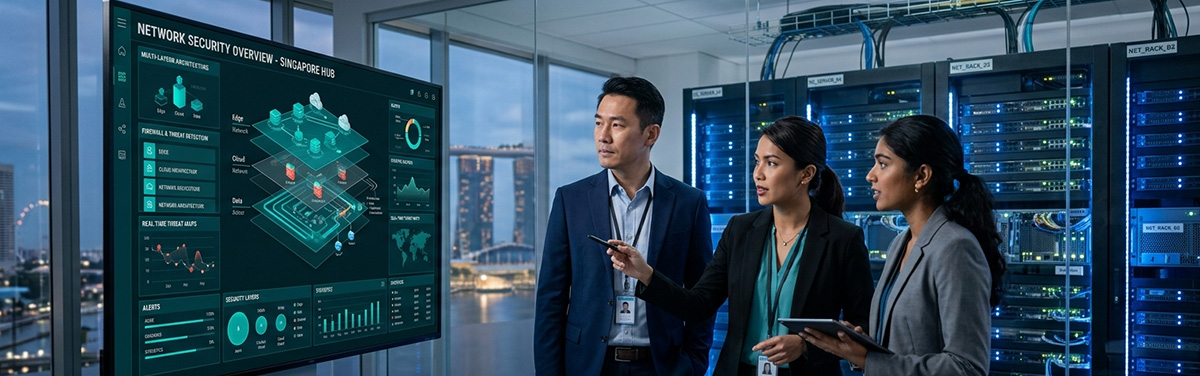
As Singapore’s appointed NQSN+ operator, SPTel offers QKD-as-a-Service, enabling organisations to secure data transmission without owning or managing their own QKD equipment.
SPTel participated in Singapore’s MAS-sponsored quantum-safe communications sandbox in 2024, alongside DBS, HSBC, OCBC, UOB, and SpeQtral. Findings confirmed QKD’s potential to strengthen network security between data centres and financial institution premises. Read the full sandbox report here.
QKD leverages quantum mechanics to distribute encryption keys with unconditional security guarantees, making them immune to quantum computer attacks.
SPTel’s trusted nodes are housed within Critical Information Infrastructure (CII), with 24/7 IOC monitoring, physically secure key storage, and ultra-low latency optical pathways for reliable key distribution.
Post-quantum cryptography standards integration ensures compatibility with NIST FIPS standards and future regulatory requirements.
Post Quantum Cryptography (PQC)
To support the adoption of post-quantum cryptography (PQC), SPTel has collaborated with Fortinet to deploy customer premise equipment (CPE) that incorporates quantum-resistant cryptographic capabilities. These devices, placed at branch offices, campuses, data centres, and remote sites, operate as secure network edges, delivering functions such as policy enforcement, segmentation, encrypted connectivity, and threat protection. PQC support is typically introduced through hybrid cryptographic mechanisms—combining classical and quantum-resistant algorithms within protocols like TLS and IPsec—allowing customer to incrementally enhance cryptographic resilience without requiring a fundamental redesign of their existing wide area network (WAN) infrastructure. With SPTel providing the underlying transport layer across local, international, and data centre connectivity, the CPE enforces security controls and protects data in transit.
Users can explore combining PQC with Quantum Key Distribution (QKD) as part of a hybrid approach for additional assurance in highly sensitive environments.
Learn more about our PQC ready next-generation firewall capabilities (Managed Virtual Firewall) that enforce zero-trust security principles for quantum-safe network architectures.
Network Diversity: Supporting Hybrid QKD and PQC Deployments
SPTel’s unique fibre pathways and geographic diversity reduce single points of failure and create resilience against coordinated quantum-era attacks. End-to-end encryption across multiple network layers protects data confidentiality and integrity. Regular security audits and quantum-readiness assessments ensure organisations remain prepared for evolving threats.
Conclusion: The Time to Act Is Now

NIST’s 2024 finalisation of post-quantum cryptography standards creates a clear roadmap for transitioning to quantum-safe security architectures. Singapore’s national quantum strategy and MAS collaborative initiatives further establish a supportive ecosystem for adoption.
Organisations adopting quantum-safe security today benefit from reduced risk exposure, regulatory alignment, and a competitive advantage.
With SPTel, you can assess your organisation’s quantum readiness, evaluate post-quantum cryptography implementation pathways, and deploy quantum-safe cybersecurity tailored to your sector and risk profile. Contact our team today to get started.