

Data Center Connectivity Solutions: How Singapore Businesses Can Build Resilient Regional Infrastructure with Multi-Route Networks
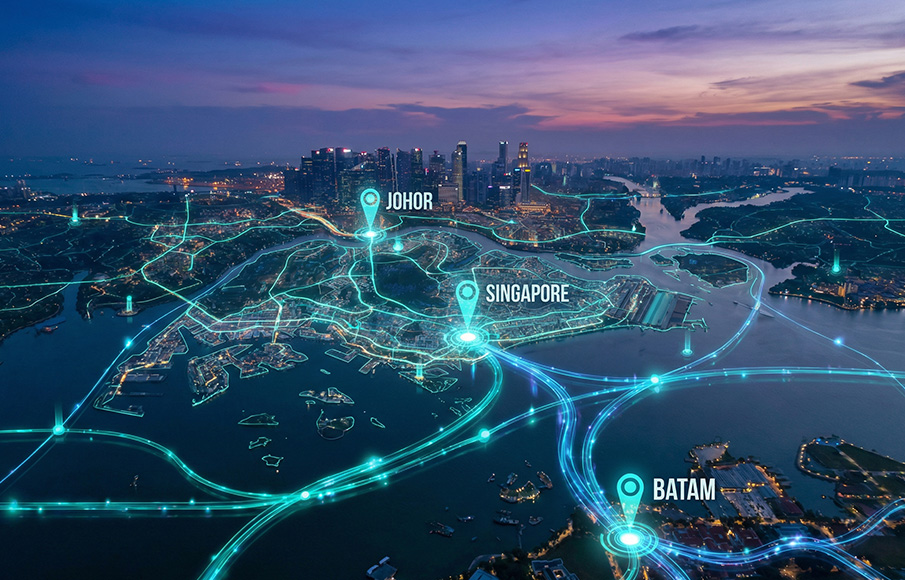
The Singapore data centre market is expanding rapidly. Valued at USD 4.33 billion in 2025 and projected to reach USD 5.60 billion by 2030, it remains one of the most sought-after markets in Asia-Pacific. Yet, with vacancy rates at just 2%, available space is increasingly constrained.
For businesses that rely solely on Singapore-based data centres, this creates real and growing risks: limited capacity, single points of failure, and tightening compliance requirements. At the same time, the region surrounding Singapore is rapidly maturing into a world-class data centre corridor.
This article explores how businesses can use diverse routing and cross-border connectivity across the Singapore-Malaysia-Indonesia triangle to build resilient regional data centre strategies.
Why Businesses Are Expanding Their Data Centre Footprint Across Multiple Countries

Challenge #1: Limited Data Centre Space in Singapore
Singapore’s data centre moratorium, first imposed in 2019 and relaxed via a pilot scheme in July 2022, has kept supply tightly controlled. In 2023, major players such as Equinix, GDS, Microsoft, AirTrunk, and ByteDance collectively allocated just 80 MW of new capacity. With roughly 1 GW of live capacity and around 500 MW under construction, supply is struggling to keep pace with demand.
The result: vacancy rates have fallen below 2%, leaving organisations with fewer options to expand locally.
Challenge #2: The Need for Regional Redundancy
Data centre outages are more common than many businesses assume. Between 2021 and 2024, 53% of data centre operators reported an outage. Power-related issues are the leading cause, affecting 54% of operators. Human error contributes to 66-80% of all downtime incidents.
Distributing infrastructure across multiple countries reduces single points of failure and strengthens business continuity. Regional redundancy is no longer a luxury. It is a strategic necessity.
Challenge #3: Regulatory and Data Sovereignty Requirements
Compliance adds another layer of complexity. Singapore’s PDPA imposes risk assessment, user consent, and safeguard requirements on cross-border data transfers. Since February 2021, enhanced penalties can reach S$1 million or 10% of annual turnover. Businesses in banking and finance also face additional obligations under the Banking Act 1970. Building a regional data centre strategy requires careful planning to stay on the right side of these regulations.
The Financial Impact of Data Centre Outages

The business case for resilience becomes clear when you look at the numbers.
Unplanned downtime costs an average of $14,056 per minute across all organisation sizes. For large enterprises, that figure climbs to $23,750 per minute, or $1.4 million per hour. Over 90% of midsize and large enterprises report that a single hour of downtime costs more than $300,000, with 41% reporting costs exceeding $1 million per hour.
Certain industries face even steeper consequences. Hospitals and medical facilities incur costs of $5,300 to $9,000 per minute. For large enterprises across sectors such as banking, healthcare, retail, and utilities, average hourly outage costs can exceed $5 million. Globally, organisations collectively lose an estimated $400 billion annually to unplanned downtime.
The message is clear: resilient connectivity is not just an IT consideration. It is a financial imperative.
The Singapore-Malaysia-Indonesia Data Centre Corridor

Johor’s Emergence as a Data Centre Hub
Just across the Causeway, Johor has become Southeast Asia’s fastest-growing data centre hub. Over 47 data centres are now operational or in development, with Sedenak Tech Park alone exceeding 1 GW in power capacity. The JS-SEZ agreement, signed on 7 January 2025, further cements the region’s significance as a cross-border data centre destination.
Malaysia’s connectivity credentials are strong too, with access to more than 20 international submarine cables offering low-latency regional links.
Batam’s Strategic Connectivity Position
Indonesia’s Batam island sits just 7 km from six major cable landing stations, making it a key node in regional connectivity infrastructure. Batam currently has 12 operational subsea cables linking Indonesia, Singapore, Malaysia, and Thailand, with three more under construction.
Two significant cables are set to strengthen the Singapore-Batam link further. The NCC, a 50 km subsea cable with a minimum of 24 fibre pairs and 1.6 Pbps capacity, is expected to be ready in Q4 2025. The INSICA cable, offering up to 20 terabits per second per fibre pair, is on track for Q4 2026.
Indonesia is also planning a trilateral data centre initiative with Singapore and Malaysia, supported by a proposed Green Super Grid.
Cross-Border Latency Performance
Latency between Johor and Singapore data centre hubs can be sub-3 milliseconds, with round-trip times to Malaysian users often under 10 ms. Compared with US West Coast or East Coast hosting, Singapore-based infrastructure can reduce TTFB by 100-250 ms when serving users across Singapore, Malaysia, Indonesia, and Thailand.
For organisations with regional customers, this performance advantage is significant.
Jurong Island: Singapore’s Gateway to the Singapore-Malaysia-Indonesia Data Centre Corridor

Singapore is not standing still either. In October 2025, EDB and JTC Corporation announced 20 hectares on Jurong Island for Singapore’s largest low-carbon data centre park, with a potential capacity of 700 MW. This addition alone would increase Singapore’s total data centre supply by approximately 50%.
Jurong Island also has 300 hectares reserved for new-energy projects, including hydrogen, ammonia, and battery storage, positioning it as a centre for sustainable digital infrastructure.
For businesses planning regional expansion, Jurong Island serves as a critical gateway into the wider Singapore-Malaysia-Indonesia data centre corridor, with direct connectivity routes into Johor and Batam.
SPTel’s Distinctive Advantage: Diverse Routing Across the Singapore-Malaysia-Indonesia Data Centre Corridor
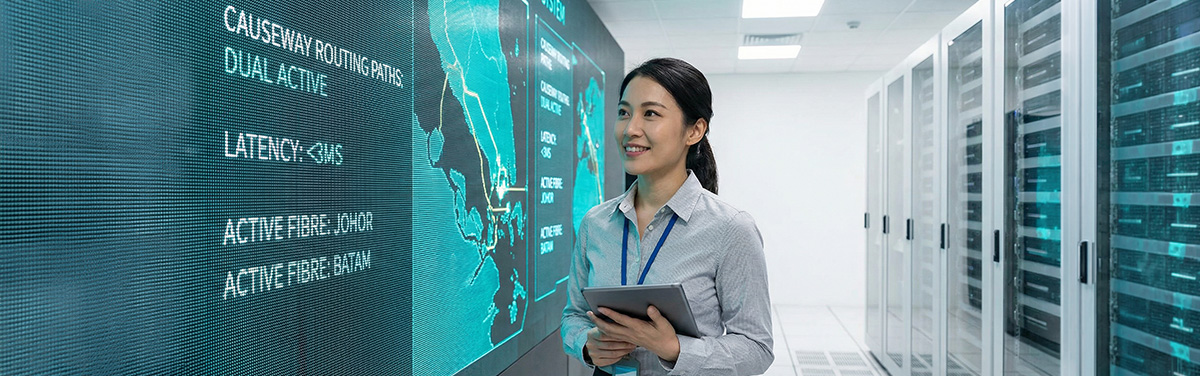
Building a resilient regional data centre strategy depends on more than geography. It depends on the quality of your connectivity provider.
Within Singapore
SPTel provides reliable connectivity to Jurong Island data centres through:
- 3 unique fibre pathways running alongside power network cables
- Additional route into Batam direct from Jurong Island
- Tested and proven routes with existing live circuits
Into Malaysia
- Fibre access over both the Woodlands and Tuas Causeways
- Access to over 10 Malaysian network providers for diversity
This ensures that no single point of failure can disrupt cross-border operations.
Into Indonesia
- Unique subsea cable path as the only cable into Batam from the west of Singapore
- Highly secured cable dedicated for gas pipeline use
- Enhanced through rock-dumped seabed directly into Batam Network Performance
- SPTel’s core network delivers ultra-low latency within Singapore at under 1 ms
- Connectivity to data centres in Johor and Batam at under 3 ms
Bandwidth scaled on demand, so businesses can increase capacity quickly without being locked into fixed plans.
The Benefits of Diverse Routing Infrastructure
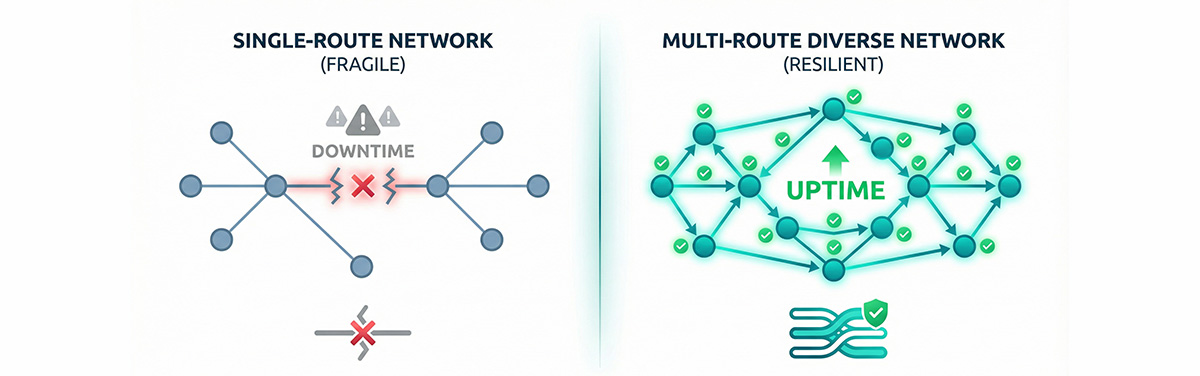
Enhanced Uptime and Reliability
The performance case for diverse routing is well supported. Organisations using redundant routing report up to a 30% boost in productivity. Using multiple Internet service providers can reduce outage risks by up to 50%, and load balancing can improve performance by 40%.
These are not marginal gains. For businesses where connectivity underpins every transaction and customer interaction, they represent a meaningful operational advantage.
Business Performance Impact
A 1-second delay in page load time can reduce e-commerce sales by 7%, a stark reminder that network performance directly affects revenue. This reality is well understood at the executive level. 91% of IT leaders now consider network reliability a strategic priority in the C-suite or boardroom.
Protecting critical data (47%) and reducing downtime (42%) now rank above cost savings as the primary drivers of network investment decisions.
Building Resilient Regional Data Centre Strategies

Uptime and SLA Requirements
Modern data centres are expected to guarantee at least 99.999% uptime. Tier 3 facilities are designed for 99.982% annual uptime, relying on N+1 redundancy and dual distribution paths. SLA penalties for falling below 99.999% uptime can range from 25% to 200% of Monthly Base Rent, making the choice of connectivity partner a contractual as well as operational decision.
2025-2026 Regulatory Requirements
Regulatory requirements are tightening. From January 2025, businesses must meet new continuity and security mandates, including penetration testing, vulnerability scanning, and incident reporting. In the finance sector, DORA mandates risk management frameworks inclusive of business continuity and disaster recovery plans.
N+1 redundancy infrastructure continues to dominate the market, reflecting growing regulatory and operational pressure to eliminate single points of failure.
Data Centre Interconnection Market Growth
The infrastructure investment landscape reflects these priorities. The Asia-Pacific DCI market was estimated at USD 3,500 million in 2024, and is projected to grow to USD 12,000 million by 2035 at a CAGR of 11.8%. Grand View Research places APAC DCI growth at a CAGR of 13.7% from 2025 to 2030, driven by the rapid expansion of cloud services and growing reliance on interconnect solutions.
For organisations expanding regionally, now is the right time to build a connectivity strategy that can scale with this market.
Implementation Considerations for Regional Expansion
Planning a regional data centre strategy requires attention to key timelines and infrastructure milestones.
The NCC cable between Batam and Singapore is expected to be ready in Q4 2025. The INSICA cable between Indonesia and Singapore follows in Q4 2026. The JS-SEZ Rapid Transit System link is on track to begin operations by end-2026, and DC-CFA2 applications close on 31 March 2026.
When selecting a connectivity partner, businesses should prioritise providers with proven diverse routing infrastructure. Cross-border latency should meet application requirements, under 5 ms for most enterprise applications. Network redundancy should be built into the architecture from day one.
Build Your Regional Data Centre Strategy with Confidence

The Singapore-Malaysia-Indonesia corridor is rapidly becoming one of the most strategically important data centre regions in Asia-Pacific. As capacity constraints tighten and regulatory requirements evolve, organisations that build cross-border connectivity into their infrastructure strategy today will be better positioned for the demands of tomorrow.
True resilience, however, depends on more than geographic diversification. It depends on having a connectivity partner with the routing diversity, low latency, and flexibility to support operations across the entire corridor.
With SPTel, you can build a regional data centre strategy backed by diverse fibre pathways within Singapore, dual-gateway access into Malaysia, and a secured submarine cable link into Batam and Indonesia. With ultra-low latency and on-demand bandwidth scaling, SPTel gives your organisation the foundation to operate reliably across borders as your regional footprint grows.